As human beings our sensory experiences, capacities and abilities help us to navigate and enjoy the world. They illuminate our experience of it as immersive and kaleidoscopic, and they can be vastly different from one another (think of colour blindness). In some modalities, they pale in comparison to the abilities of the creatures we share the planet with (for example cats have a ‘righting reflex’ which allows them extraordinarily, to twist mid-air of falling, hence why they can land on their feet).
Senses and how we react to what stimulates them are something we can’t often see. But they can hugely influence our comfort and discomfort in ways we may not always be aware of in the moment.
Our senses influence wellbeing
I attended a free webinar for work once that really helped me contextualise this for myself. It set in motion for me ideas about how to meet and balance one’s daily sensory needs as they fluctuate and change, both due to personal and environmental reasons.
It really drove home the idea that we can have some control over achieving a sense of personal sensory regulation as a baseline for wellbeing and productivity. For example – a too hot or cold room may be uncomfortable and distracting. So the rationale for adjusting the air con, heating or windows in this situation becomes a no-brainer.
We each have eight senses
The first fact I learned in that webinar was that there are eight senses, rather than the standard five we have been taught.
Instead of only sight, sound, touch, taste, and smell there are three more.
Vestibular is our sense of balance spatial awareness and movement.
Proprioception is our awareness of body in space.
Interoception is our sense of internal processes and signals: hunger, thirst, tiredness, emotions and feelings.
Sensory balance and regulation
Sensory regulation will be different for each of us and is relevant for each person too. There is this myth or assumption that sensory hyper or hypo – sensitivity is only relevant to neurodivergent folk, but there are several human experiences which may encompass heightened or less responsive reactions to sensory input is present for many of us. This is inclusive of any physiological state or condition which involves brain and nervous system changes or differences, such as anxiety, trauma responses, nerve or brain injury.
In general, regardless of the possibility of any functional or other sensory issues, we are all on some sensory level; attracted to, or more repelled by stimuli and experiences precisely due to how our personal sensory profile impacts on our preferences.
For example regardless of a condition or diagnosis or it’s absence we may like and so try to find, or be averse to so avoid: sour or sweet tastes, or direct sunshine or heat for example.
Some people love or hate the smell of petrol, or some the sound of loud bass notes in music. Some prefer a brisk run, others a gentle stroll or to be in or out of nature. I suspect if we all broke down the reasons for why we enjoy or dislike some particular environments, foods, and hobbies, perhaps many of the reasons would be about how our senses are activated in those particular activities, places or situations.
This is precisely due to the idea that the world can stimulate our senses that feel pleasant, unpleasant, tolerable or neutral to each of us and this may change from environment to environment as well as person to person.
Senses can fluctuate due to biology and environment interacting
Where personal physiology and biology makes things more complicated is when our body systems fluctuate and vary in their ability to process sensory input. This can happen naturally due to the interaction and modulating impact of our hormonal and neurochemical systems.
Both systems interact together to govern our brains and bodies (our nervous systems). Some chemical messengers act as double-agents accross both systems by being both hormones and neurotransmitters. For example noradrenaline (a mobilising ‘get-ready’ agent) and dopamine (a motivating ‘get and keep going’ chemical).
When a change of environment happens (for example low to high stress), this can triggers a rush of noradrenaline and dopamine amongst others. These chemicals can then in a moment, drastically alter how your senses filter the world around you. Think of times you have felt suddenly physically or mentally exhausted due to too many back to back meetings and unable to think clearly. Or becoming hot, and irritable or even nauseous. Or how your mood, physical energy, pain threshold and thinking capacity can alter due to hunger or thirst.
A pragmatic approach to adjusting your environment
So now we are aware of how our senses, the environment and how our individual capacity for them can fluctuate and interact. This information can be useful to develop practical strategies and plans to cope with some environments or circumstances that we may often find ourselves in.
Perhaps knowing this all might help us to expand our sense of options when it comes to activities or environments. This may be because we have been unknowingly avoiding situations or places that made us uncomfortable. Or we may be tolerating a situation or environment that dysregulates or discomforts us without us noticing. Beginning to notice may therefore make it possible to change what’s possible, so feel more comfortable, balanced and regulated. For example meeting in quieter or more stimulating environments as needed.
See the below figure for an example of how you may be able to table your own sensory profile. Perhaps you can use this type of map for employers, family, friends or yourself as a helpful tool towards sensory change and comfort:-
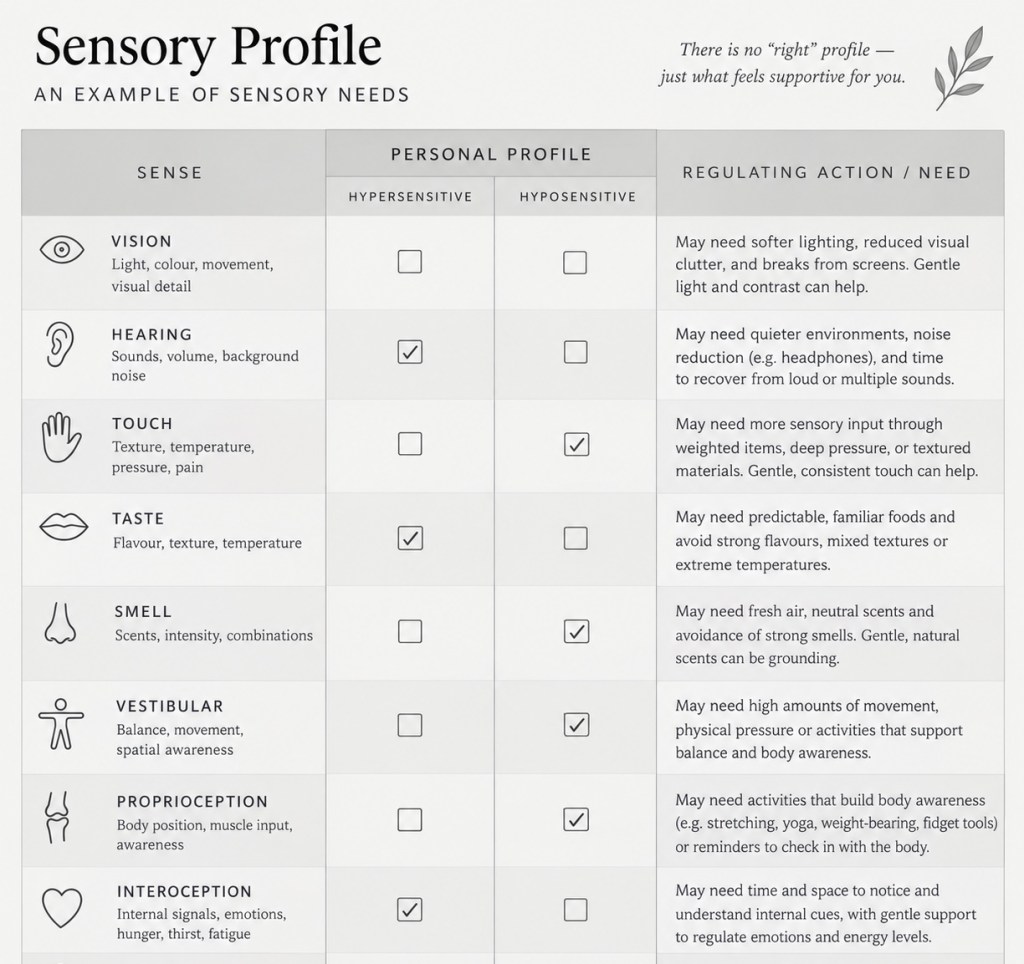
As a general rule if you are hypo-sensitive in one sensory modality, you may need to seek more stimulation. While if you are hyper-sensitive, you could need to find or seek less of or a reduction in stimulation, to feel more regulated and balanced emotionally and physically.
Another spanner in the works to discovering your sensory profile could be that whether you are under, neutral or over sensitive in one sensory area or other, might fluctuate for various health reasons or across different situations. Or you might have built up really good defences to cover your sensory reactions (like mentally disconnecting from your body), so it may be hard to spot patterns!
Strategies like intentional mental body scans ( like a quick version of this meditation here) in different environments can be very helpful for figuring this out.
Takeaway
A more a sensory mindful and aware approach to adaptations and adjustments in our lives may be able to help us with enjoying life and our relationships. It may even perhaps contribute to understanding other people’s approaches and reactions to life and relationships too. Perhaps also, if we give or allow ourselves a little more of what sets-off sensory pleasure and joy for us, life may feel a little more vivid and enjoyable?
I hope this demystifies senses and associated adaptations a bit.
Until next time, happy sensing out your life!
© 2026 Lorraine Welch. All rights reserved

